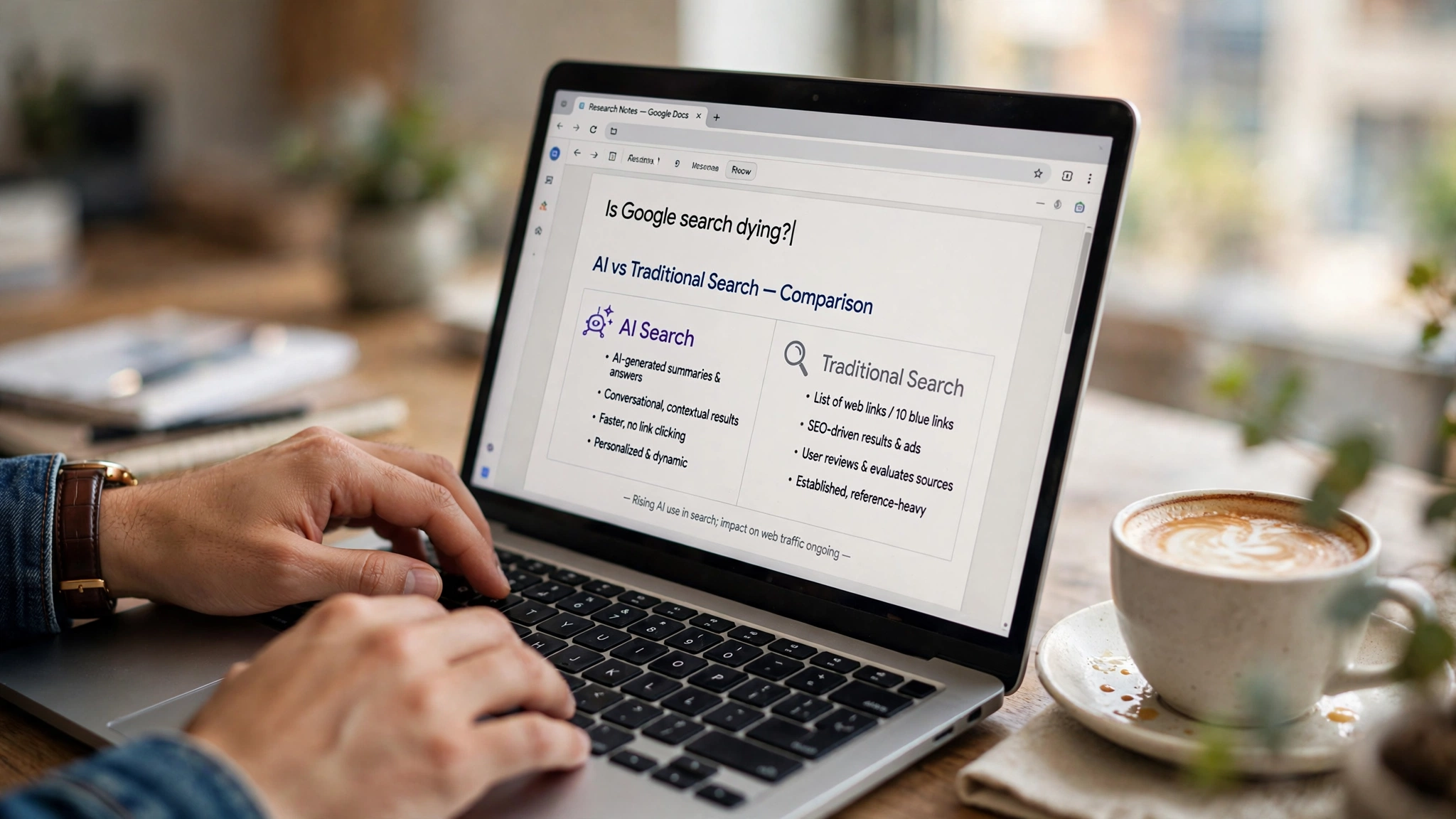
Perplexity AI vs Google is the biggest debate of 2026. The urgent query is now not about which search engine is slightly quicker; it’s whether conventional search—relying on typing keywords and hunting through rows of blue hyperlinks—is completely dying.
At the epicenter of this disruption are clashing philosophies. On one side stands Google, aggressively defending its empire with AI Overviews, striving to hold billions of users hooked to its platform. On the opposite side is Perplexity AI, the newly minted tech unicorn worth a staggering $20 billion, which rejects the search engine label totally, branding itself as a lively Answer Engine.
Are we truly witnessing the end of the traditional search era? Let’s study the hard numbers, user conduct shifts, and technological mechanics defining the internet in 2026.
Perplexity AI vs Google: Document Indexing vs Synthesis Engines
Traditional search operates on a basic index-and-retrieve model. A user enters a query, Google scans its vast index, and it serves a list of external websites. The cognitive load of clicking through, reading, filtering out ads, and synthesizing the information falls entirely on the user.
In 2026, user patience has hit an all-time low. This is where the structural division between the two platforms becomes glaringly obvious:
The Google Dilemma: Google has countered by placing AI Overviews at the top of its search results. However, Google faces a severe structural conflict: its fundamental business model relies on advertising revenue driven by user clicks. If Google gives a perfect answer immediately, it deprives its ad ecosystem of traffic.
Because of this friction, users are increasingly segmenting their behavior. They turn to Perplexity for deep synthesis and synthesis-driven research, reserving Google for operational or navigational tasks.
The Data Reality: Market Share and Corporate Integration
Looking at tech forums, it is easy to assume Google is entirely obsolete. However, real-world market metrics tell a more nuanced story. The 2026 market landscape shows a massive disparity in scale, but a rapid acceleration in AI adoption:
Google’s Resilience: Google still commands an overwhelming 89.5% of the global search market share, processing roughly 14 billion daily queries. Its AI Overviews feature has scaled globally, touching over 2 billion monthly active users who interface with AI directly inside the classic interface.
Perplexity’s Hyper-Growth: Conversely, Perplexity AI has officially crossed 45 million monthly active users (MAUs), generating a running annualized revenue rate (ARR) of over $200 million. More importantly, its strategic integrations are paying off; major hardware manufacturers, including Samsung with its flagship Galaxy S26 lineup, have deeply integrated Perplexity as a core, out-of-the-box system tool.
While Perplexity’s monthly volume represents a small fraction of Google’s global scale, its audience is highly concentrated among high-value knowledge workers, developers, and corporate researchers. According to a recent Gartner study, traditional search volume is projected to drop by roughly 25% by the close of 2026, with that vital traffic permanently bleeding over into conversational AI interfaces.
Perplexity AI vs Google Head-to-Head: Where Platforms Win and Lose
When running identical test queries across both platforms, it becomes clear that neither engine is an absolute winner. Instead, they occupy entirely different operational strengths:
| Feature | Perplexity AI | |
| Research | Exceptional | Moderate |
| Local Search | Weak | Unmatched |
Exceptional. Delivers clean, sourced summaries across complex, multi-variable topics instantly.
Moderate. Requires manual reading and cross-referencing across separate tabs.
Local Search & Mapping
Weak. Limited to text explanations; struggles with spatial awareness and real-time business logistics.
Unmatched. Seamlessly tied to Google Maps, live operational hours, reviews, and physical directions.
E-Commerce & Shopping
Moderate. Summarizes options but lacks deep merchant infrastructure.
Exceptional. Direct access to live price tracking, inventory, reviews, and secure checkout pipes.
Real-Time News
Monetization Noise
Zero. Relying heavily on a premium subscription tier ($20/month) to keep results completely bias-free.
High. Ads now populate roughly 25% of the real estate, including inside AI Overviews.
Perplexity wins unequivocally when you need to understand why something happened, how a complex code block works, or what the consensus is on a medical breakthrough. Google wins when you simply need to find a mechanics shop nearby open past 8 PM or book a flight to London.
The Algorithm War: Where Do They Find Their Data?
A fascinating distinction lies in the backend ingestion mechanics of both tools. Data from the 5W AI Citation Index shows a surprising divergence in what these engines consider “authoritative” content:
Perplexity’s Aggregation Bias: Perplexity relies heavily on community-driven open web spaces, with forums like Reddit making up a major percentage of its cited text for subjective queries. It heavily biases recent data, giving three times more weight to articles, papers, and threads published within the last 30 days.
Google’s Authority Bias: Google continues to lean on historical Domain Authority. It prioritizes direct official brand domains, established legacy media publishers, YouTube videos, and its own proprietary internal data networks.
This means if you search for raw, unvarnished consumer reviews on a new tech gadget, Perplexity bypasses corporate PR to synthesize real user complaints from Reddit. Google, by contrast, is more likely to serve optimized media reviews or sponsored e-commerce links.
The Death of SEO: Entering the Era of GEO
This paradigm shift is forcing an existential crisis upon digital marketers, content creators, and businesses worldwide. Traditional SEO (Search Engine Optimization) is rapidly fragmenting into GEO (Generative Engine Optimization) or AEO (Answer Engine Optimization).
For two decades, corporate success meant ranking in the top three slots on Google’s first page. In 2026, the new metric for success is entirely different: “Is an AI model citing your brand name inside its generated answer paragraph?”
First-Party Data and Research: Re-hashed blog posts are ignored by AI engines. Brands must publish original case studies, proprietary surveys, and unique expert commentary to be pulled as a reference source.
Structured Q&As: Content organized in explicit question-and-answer formats matches the natural language processing patterns of conversational LLMs perfectly.
This Perplexity AI vs Google analysis proves the future is hybrid.
Final Verdict: Evolution, Not Extinction
The ten-blue-links model is dying in this Perplexity AI vs Google era because it forces the human user to act like a computer processor—sorting through noise to assemble a coherent picture.
Google will not disappear overnight. Its structural ecosystem—anchored by Android, Google Maps, Chrome, and YouTube—is too deeply woven into global digital infrastructure to disappear overnight. However, Perplexity AI has successfully broken the monopoly by proving that there is a faster, cleaner, and fundamentally more intelligent way to query human knowledge.
The future of this Perplexity AI vs Google battle proves digital exploration is a hybrid ecosystem. We’ll keep using Google as our transactional utility engine to navigate the physical world, but we will rely on Perplexity as our intellectual engine to navigate ideas. Search isn’t dead; it just finally learned how to talk.
Is Perplexity AI better than Google in 2026?
Yes, for deep research and complex questions, Perplexity AI is better than Google because it gives a direct, sourced answer instead of 10 blue links. However, for local search, maps, and shopping, Google is still the best.